What is team velocity?
Driving Velocity
As described by Catia Oliveira in Velocity on Scrum Alliance, "velocity is velocity. And velocity is measured . . . as velocity is." I particularly like the way Oliveira explains velocity because it is simple and relatable. She relates a project's velocity to driving.
How do you measure your velocity while driving? (Imagine the speedometer is broken.) You've been driving for the last two hours, you've gone 160 kilometers, so you know your average velocity is 80 km per hour.
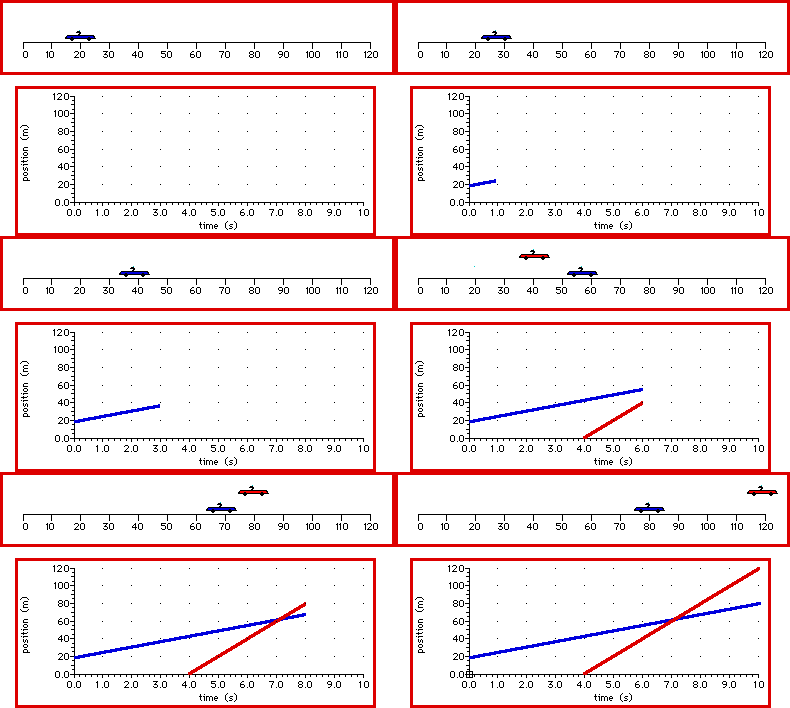
http://www.physicsclassroom.com/mmedia/kinema/fs.gif
Team Velocity
A project's velocity is measured in a similar way. "Velocity is the number of story points completed by a team in an iteration." To obtain an average velocity, simply add velocity from every iteration (distance) and divide by the number of iterations (time).

https://www.scrumalliance.org/scrum/files/e3/e3a2ff2a-27a2-444c-81af-c2e8dbfb3128.jpg
Importance of Team Velocity
Team velocity is important because it allows the team to predict how much scope can be deliver by a specified due date. It allows the team to understand its limits while defining an amount of scope that can be committed within a sprint.Can we compare velocity of different teams?
Product owners may want to compare the velocity of different teams to see which teams are more effective. However, comparing velocity will not help in comparing teams because they are using different units for their story points. Story points are relative to the team. One team can assign 20 points as an hour of work while another team can assign 60 points to the same amount of work.
One effective way to compare work ethic of two different teams is to compare their velocities to their team capacities.
What is team capacity?
According to Avienaash Shiralige, "team capacity is calculated as per people availability in that sprint." It must be determined before planning the sprint, so scope of deliveries can be estimated.
Let’s take an example.
Say team is of 5 people, then total capacity assuming 8 hour day, 2 weeks sprint(10 days) is = 5*8*10 = 400 hours. Planning for this total capacity will be disaster. It will lead to team working over time, rushing towards the end, quality cuts and low team morale.In reality, management never plans for 100% capacity. They use a focus factor to determine real capacity. The factor usually lies in the range of 0.6 to 0.8. Therefore, a five person team working full-time would really only have a capacity ranging from 240 (400 * 0.6) to 320 (400 * 0.8) hours.
Why isn't capacity at 100 percent?
There are many factors in agile development that affect team capacity.
- Team vacation
- Scrum meetings
- Defects
- Training/Education
- Administrative duties
- Less mature team
- New to agile
- Complex product or new technology
Conclusion: Team velocity versus team capacity
To truly understand a team's work ethic we must compare its velocity to its capacity. Management must understand the time estimations behind story points and compare the time spent on tasks with team capacity to see if the team is utilizing its resources effectively.

https://i-msdn.sec.s-msft.com/dynimg/IC372417.png
References:
Oliveira, C. (2014, February 6). Velocity. Retrieved November 3, 2015, from https://www.scrumalliance.org/community/articles/2014/february/velocity
Shiralige, A. (n.d.). How To Do Effective Capacity Planning on The Scrum Team. Retrieved November 3, 2015, from http://www.agilebuddha.com/agile/how-to-do-effective-capacity-planning-on-the-scrum-team/

No comments:
Post a Comment